Business Process Management
All learnings from handling and leading a business process in my previous experience
6/23/20252 min read
Having led a business process for close to three years and contributed to it for over five, I’ve learned that most process failures are not caused by lack of effort, but by lack of structure. Over time, I’ve developed a simple, adaptable framework to design, optimize, and govern business processes—regardless of function or industry.
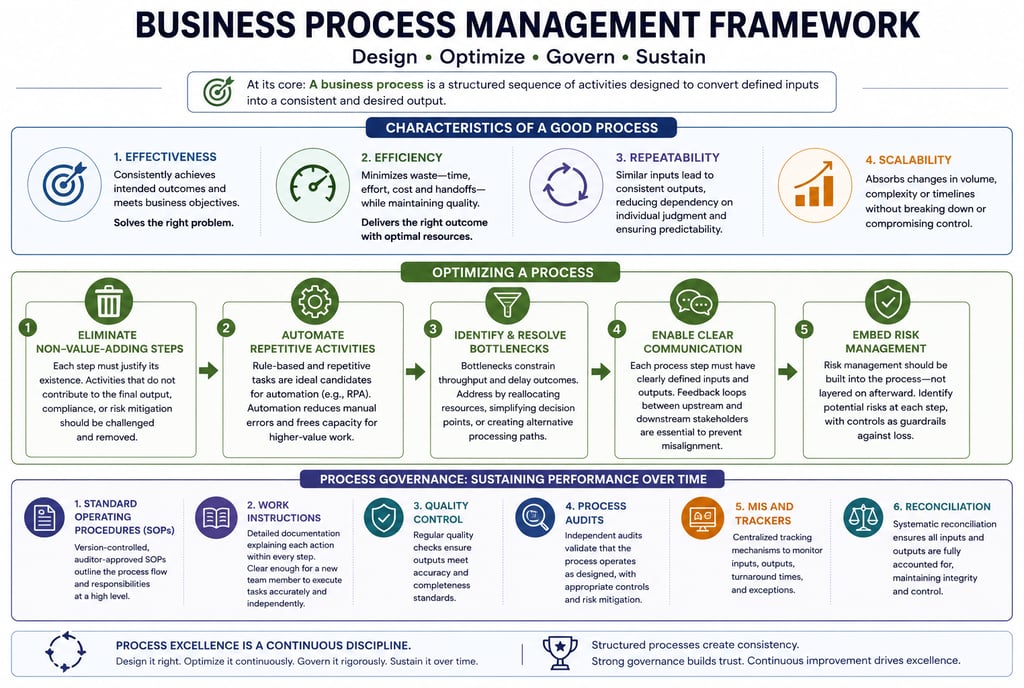
At its core, a business process is a structured sequence of activities designed to convert defined inputs into a consistent and desired output.
Characteristics of a Good Process
A well-designed process exhibits the following characteristics:
1. Effectiveness
The process consistently achieves its intended outcome and meets defined business objectives. An effective process solves the right problem.
2. Efficiency
The process minimizes waste—time, effort, cost, and handoffs—while maintaining quality. Efficiency ensures the outcome is achieved with optimal use of resources.
3. Repeatability
Similar inputs lead to consistent outputs, reducing dependency on individual judgment and ensuring predictability.
4. Scalability
The process can absorb changes in volume, complexity, or timelines without breaking down or compromising control.
Optimizing a Process
Once a process is clearly defined, optimization focuses on improving flow, reducing friction, and strengthening outcomes.
1. Eliminate Non–Value-Adding Steps
Each step must justify its existence. Activities that do not contribute to the final output, compliance, or risk mitigation should be challenged and removed.
2. Automate Repetitive Activities
Rule-based and repetitive tasks are ideal candidates for automation through tools such as RPA. Automation reduces manual errors and frees capacity for higher-value work.
3. Identify and Resolve Bottlenecks
Bottlenecks constrain throughput and delay outcomes. These can be addressed by reallocating resources, simplifying decision points, or creating alternative processing paths.
4. Enable Clear Communication
Each process step must have clearly defined inputs and outputs. Feedback loops between upstream and downstream stakeholders are essential to prevent misalignment.
5. Embed Risk Management
Risk management should be built into the process—not layered on afterward. Potential risks must be identified at each step, with preventive and detective controls acting as guardrails against loss.
Process Governance: Sustaining Performance Over Time
Optimization improves a process; governance sustains it. Without governance, even the best-designed processes deteriorate over time.
1. Standard Operating Procedures (SOPs)
Version-controlled, auditor-approved SOPs should outline the process flow and responsibilities at a high level.
2. Work Instructions
Detailed documentation that explains each action within every step. These should be clear enough for a new team member to execute tasks accurately and independently.
3. Quality Control
Regular quality checks ensure outputs meet accuracy and completeness standards.
4. Process Audits
Independent audits validate that the process operates as designed, with appropriate controls and risk mitigation in place.
5. MIS and Trackers
Centralized tracking mechanisms to monitor inputs, outputs, turnaround times, and exceptions.
6. Reconciliation
Systematic reconciliation ensures all inputs and outputs are fully accounted for, maintaining integrity and control.
I’ve built this framework to be adaptable across roles and industries, and I intend to apply and refine it in every position I take on. For me, process excellence is not a one-time exercise—it’s a continuous discipline grounded in structure, accountability, and thoughtful improvement.
Portfolio
Showcasing my skills, education, and experiences online.
Connect
shubhamghotankar@gmail.com
+32 0465 86 03 92
© 2025. All rights reserved.